
Managed IT Services vs. In-House Support: Which Is Best for Your Melbourne Business?
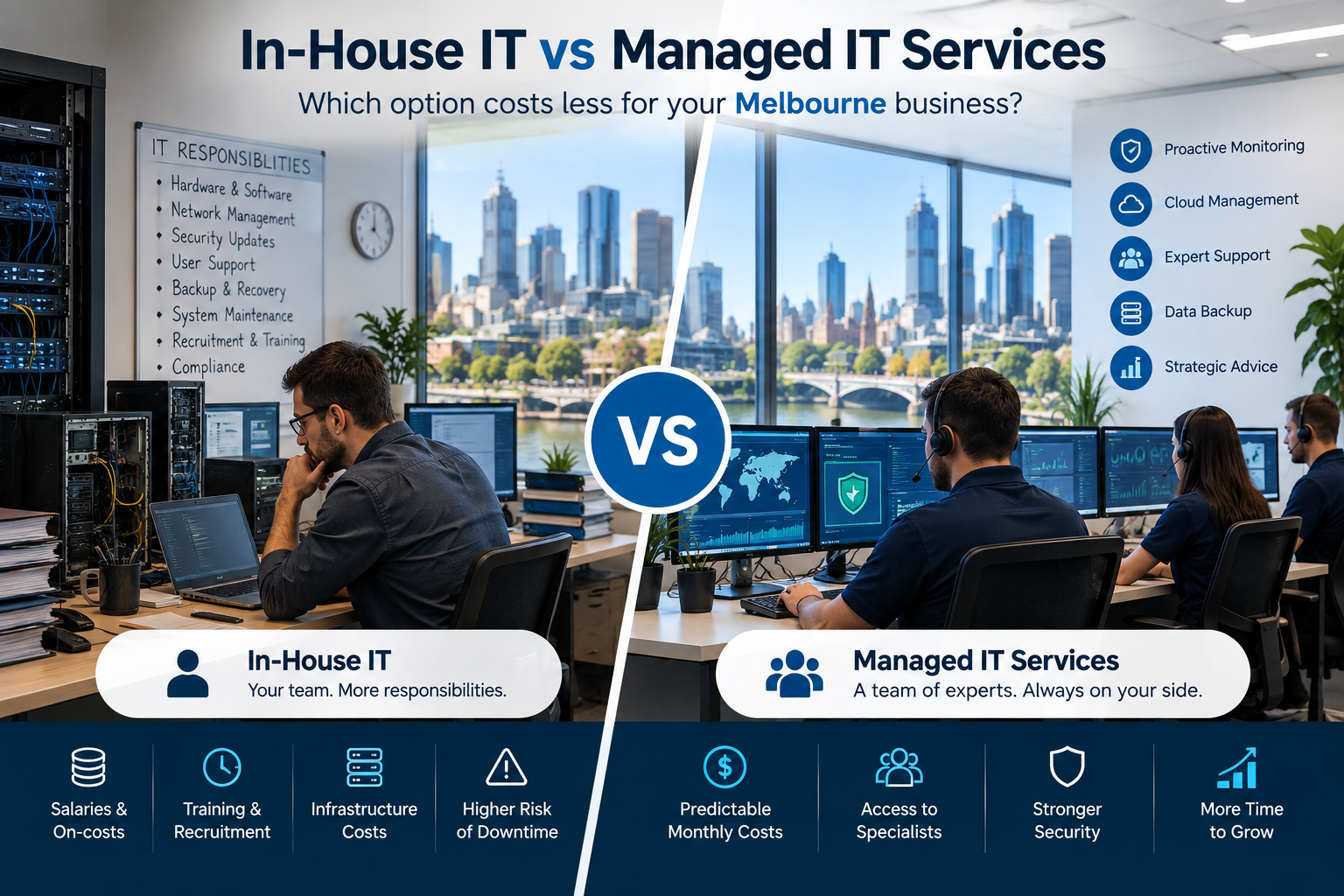
Choosing between an internal IT employee and an external provider affects more than your IT budget. It shapes response times, cybersecurity, system maintenance and what happens when your only technical person is unavailable.
For Melbourne businesses, the decision usually comes down to:
- How much technical work your team generates.
- How much specialist knowledge you need.
- Whether you need ongoing monitoring and support.
- How much operational risk you can comfortably carry.
MCG Computer has supported Australian businesses since 1991. Our managed IT services in Melbourne focuses towards offering reliable technological support to businesses. This comparison highlights where each model applies, what costs are often overlooked and when a blended approach is more appropriate.
Managed IT services is the best option for businesses that require extensive technical expertise, proactive maintenance and predictable support without the need to develop a complete internal team. In-house IT support can suit organisations requiring deep internal knowledge and daily technical ownership. MCG Computer’s approach focuses on matching support structures to workload, risk and business requirements.
Is Managed IT Better Than In-House IT for a Melbourne Business?
Neither model is automatically better. Managed IT generally suits businesses that need wider expertise and consistent coverage, while in-house IT suits organisations with enough ongoing workload to justify dedicated technical staff.
| Factor | In-House IT | Managed IT |
|---|---|---|
| Business knowledge | Deep internal knowledge | Requires documented knowledge transfer |
| Technical breadth | Depends on staff capability | Access to multiple specialists |
| Staff absence | Can create a coverage gap | Team-based coverage |
| Cost structure | Salary, leave, tools and training | Recurring service cost |
| Monitoring | Depends on internal resources | Can be built into the service |
| Scalability | Recruitment may be required | Capacity can usually be adjusted |
| Strategic support | Internal priorities | Provider roadmap and specialist input |
The important difference is capacity versus proximity. An internal employee sits close to the business and understands its people. A managed provider can bring broader technical resources when networking, cloud, cybersecurity or infrastructure issues require specialist knowledge.
What many comparisons miss is the cost of interruption. If an internal IT person spends the morning resolving a printer problem, they may not have time to review backups, patch systems or work on a security issue. The opportunity cost sits outside the IT salary.
Choose The Right IT Support Model
Where In-House IT Has an Advantage
In-house support can work well when:
- Technology directly forms part of your core business operations.
- You have enough daily IT workload to keep several technical roles productive.
- Your systems require constant internal attention.
- You need immediate physical access to equipment.
What Does a Managed IT Provider Actually Take Care Of?
A managed provider takes ongoing responsibility for defined areas of the technology environment, rather than simply waiting for staff to report problems.
Typical responsibilities can include:
- Proactive system monitoring.
- Software updates and patch management.
- Backup oversight.
- Remote and onsite technical support.
- Microsoft 365 and cloud administration.
- Network management.
- Security monitoring.
- Vendor coordination.
- Technology planning.
This differs from occasional technical assistance. The aim is to reduce recurring issues and create clearer ownership of routine IT work.
The Operational Difference
An IT consultant may help with a specific project or technical decision. A managed provider can take responsibility for recurring operational tasks as part of an agreed service.
That distinction matters when your business needs someone to monitor systems, maintain devices and respond to incidents while your staff concentrate on their own roles.
Is Managed IT More Cost Effective Than Hiring an Internal IT Person?

Managed IT can be more cost effective when a business needs several areas of technical capability but does not have enough workload to justify multiple internal specialists.
A fair comparison should include the complete employment cost, rather than salary alone.
| Salary or Service Fee | Salary | Recurring fee |
| Superannuation and Leave | Business responsibility | Included within provider model |
| Recruitment | Internal cost | Provider responsibility |
| Training | Internal budget | Provider capability |
| Specialist Skills | Additional hiring may be needed | Available through provider team |
| Monitoring Tools | Business purchases and manages | May form part of service |
| Staff Coverage | Requires backup | Built around service arrangements |
The right calculation also considers downtime, management time and delayed projects.
For a certain business, small business IT support from a structured provider can provide access to several areas of expertise without employing a separate person for every function.
What many experts miss is the utilisation problem. An internal employee may be overloaded during an outage and underused during quieter periods. A managed model spreads specialist capacity across clients, making that capability available when required.
When Does In-House IT Make More Sense?
In-house IT becomes more attractive when technology generates enough continuous work to justify dedicated roles and backup coverage.
Consider internal staffing when:
- Your business has a large technology estate.
- You need technical staff onsite every day.
- Your applications require constant internal administration.
- You already have several IT employees and need to expand the team.
- Internal technology knowledge is central to daily operations.
However, one internal employee can create a single point of dependency and absence of the same can can quickly expose a coverage gap.
A Practical Alternative
A blended structure can combine an internal IT lead with an external provider.
The internal person can manage business priorities, users and onsite requirements. The external team can provide specialist assistance, security oversight, projects and additional support capacity.
This can work particularly well as an organisation grows and the workload becomes too broad for one person.
How Should Melbourne Businesses Choose Between the Two?

Start with workload, risk and required capability rather than asking which model is universally cheaper.
Ask these questions:
- How many IT issues occur each month?
- Which systems require proactive monitoring?
- Who handles security incidents?
- What happens when the internal IT person is unavailable?
- Which specialist skills are missing?
- Who owns system documentation and administrator access?
- What support is required outside normal office hours?
- Which IT projects are likely during the next 12 to 24 months?
You should also take a look at your current IT solutions and compare them to your future needs. For instance, as an organization’s systems become more connected, it may require more robust data network security, cloud administration or specialist cybersecurity support.
The best configuration is one that provides enough technical capacity without unnecessary complication or dependency.
Reduce IT Risks And Support Gaps
Conclusion
The right choice depends on the size of your business, your workload, and risk and technical requirements. In-house IT offers close business knowledge, but managed support can offer wider expertise, continuity and proactive maintenance without building a large internal team.
MCG Computer has been providing reliable managed IT services and we can help you assess whether internal staffing or a blended model will meet your current requirements. Get in touch with us to know the practical options for your business.
FAQs
Can an internal IT employee work with a managed provider?
Yes. In addition, a managed provider can support an internal employee with specialist knowledge, monitoring, security, projects or additional coverage. Outsourcing responsibilities helps businesses to avoid putting too much technical responsibility on one person and also provides more capacity during major changes or incidents.
What should I check before signing a managed IT agreement?
Check precisely what is included in the monthly service, response arrangements, onsite support, security responsibilities, backup management, project charges, contract terms and exit processes. Enquire who has the administrator credentials and the documentation. Clear responsibilities reduce disputes when a serious technical problem happens.
Is cybersecurity included in every managed IT service?
No. Security coverage varies between providers and packages. Ask whether patching, endpoint protection, monitoring, incident response, email security and security reviews are included. If your risk profile requires more specialised protection, managed cybersecurity services may need to sit alongside general IT support.
Can IT support also cover our website?
It depends on the provider and your requirements. Website design services, hosting, maintenance and business IT support can involve different technical responsibilities. Confirm whether website systems sit within the provider’s support scope or remain with a separate specialist.